It felt like a punch in the gut.
I wasn’t sure I heard him correctly, so I asked again
“What did you say to me?”
My colleague of almost 6 months, turned around in his chair, faced me and said it again.
“I don’t want you to take this personally, but you are very arrogant in the way you talk. It sucks and you need to change it.”
Another punch in the stomach. I could feel the color drain from my face.I could feel my shoulders tighten, my breath getting a little shallow.
Imagine a scene of any 19th-century war movie, the moment when the army is just about to launch into a counter-attack. That’s how my ego felt at that moment. Shields Up. Ready for war.
I want you to imagine yourself in my place. Think what happens when you get criticized.
Facing criticism and negative feedback always set off alarm bells in my head. It was affecting both — my professional as well as my personal life.
I wanted to change that.
But wanting something is not even close to actually doing something and getting the desired result.I knew I had to pull out the big guns and do the work required.
This is my story of how I conquered my fear and my insecurities and learned to fall in love with criticism.
Hey Jerk, You are Being an A**hole!
“People in my company can say that to me.”
This is Ray Dalio, the 69-year-old billionaire founder of Bridgewater Associates, one of the largest hedge fund on the planet today.
“If your objective is to be as good as you can possibly be, then you’re going to want that.”
Ray has built his firm on the principle of “Radical Transparency”. Every criticism, every opinion, out in the open. By doing that, Ray believes he has created a company where the best ideas win.
“One of the biggest tragedies of mankind is people holding in their opinions in their heads, and it’s such a tragedy because it could so easily be fixed if they put them out there and stress-tested them in the right way.”
Ray Dalio
But the real question is
“Is the ego ready to hear it? Can we look past denial and defense? Can we practically implement radical transparency in our personal lives”
My experiment with Radical Transparency
After I read more about Ray Dalio, I decided to experiment with Radical Transparency.
My objective was to get comfortable with criticism. I wanted to test if my ego could look past denial and defense. I wanted to see if I put self-improvement as my main motivator, would it become easier to accept criticism?
So, I created a Broadcast list. It included my friends and family and I asked them to criticize me and be brutally honest in their feedback.
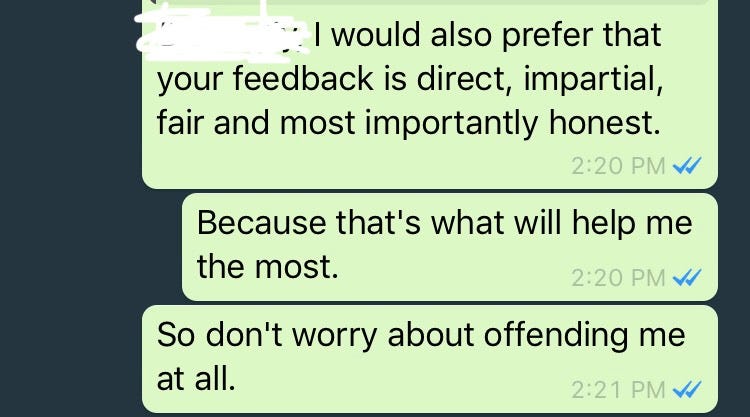
I was anxious and afraid of facing negative feedback and my deep-rooted insecurities crept up.
“What if I am not as good as I think I am? What if they all don’t like me?”
The first criticism that I received was the most painful.

Again, that feeling of a solid punch in the gut. I could feel my ego starting to go in a hyper-defense mode.
But then I stopped myself. I reiterated the purpose of this exercise in my head. Even said it out loud.
“If I am doing something wrong and sucking at it, I want somebody to tell me. I don’t want to have an illusion of competence. I want to have the real thing. And if I am bad, I want to improve.”
I took a deep breath.
Trying to slowly allow
Quite later did I realize that I was operating in a Growth Mindset. Those who are familiar with Carol Dweck’s work will understand what I mean.
The growth mindset is based on the belief that your basic qualities are things you can cultivate through your efforts.
I did this self-awareness reality check with all the messages I received.
The outcome?
My life changed for good.
I could short-circuit my usual response
I realized that as many times as I repeated my message of self-improvement, my ego became less and less hyper defensive. Think of it as putting water into fire.
I could listen more objectively
And I mean, actually listen. Not with the intention to respond, but with the intention to understand.
It increased my self-awareness.
Once I received negative feedback, I introspected and I looked out for similar situations in my daily life.
I got better control over my reaction.
By being cognizant of how I reacted, I could test myself and see how I performed. This meant that I was giving signals to my brain and was changing the response pattern.
Charles Duhigg in his book Habit, explains the above process in terms of a cue-routine-reward framework.
I improved.
Once I realized that I was actually bad at something, I started reading up more on how to get better.
It was similar to being handed a personal audit report. I knew the As-Is State of things. I could now start working towards the To-Be State of things.
If you suck, take it personally.
Look, if you are bad at something, wouldn’t it be actually great to know about it?
After my experiment, I realized I would rather know how bad the bad is and how good the good is so I can do something with it.
For anyone who struggles to deal with criticism, here is what I have learned from my experience.
The next time someone criticizes you,
Don’t react immediately
I know this can be extremely difficult to do when someone says you suck to your face. But trust me, the most important thing is to not react at that time.
Take a deep breath and slowly let that emotion go. Go out for a walk, get away from that place if possible. Tell the person criticizing you “I need to process this. Let me get back to you.”
Check the credibility of the source
When somebody criticizes you, you are receiving data, both good and bad. Your job now is to analyze this data for its validity.
Ask yourself “Can I trust the person who gave me the feedback? Is this someone who will give credible data?” You are the best judge of this.
Remember, not every criticism should be taken to heart. You must have heard that phrase “You can’t judge a fish by its ability to climb a tree.” That’s what I am trying to say here.
Introspect
This might be difficult, especially if you are new to this. Here is a trick that will help.
Write down the criticism you receive in a notebook or make a note of it on your phone and ask yourself a question. For example,
“Alex said that I am not authentic in my writing. Is this true?”
The next time you are in a situation or an activity which you were criticized for, remember the question. Ask yourself that question.
It will help you make an unbiased observation about yourself.
Channel your growth mindset
Remind yourself why you are doing this whole exercise again.
Write this down. Say it out loud.
“The first step of getting better at something is knowing and accepting that I am not good at it right now. But slowly, I can get better.”
When you make self-improvement your driver, it won’t feel a waste of time. It will keep you going. It will keep you on track.
Build a Challenge Network for yourself
A challenge network is the group of people that you trust to push you to get better. They tell you the stuff you don’t want to hear but need to hear.
Make a list. Add your friends, family members and colleagues to them. These are the people you really trust and you know they wish the best for you.
It worked for me. It will work for you too!
I kept at it and I got the results.
If I can do it, trust me you can definitely do it.
I can promise you that if you start changing your perspective on criticism and how you react to it, you will slowly start loving it. From being a tool of negativity, it will become a tool of positive change.
Changing the way I looked at criticism really helped me in my personal growth and development. Even if you are not as obsessed as me about it, I suggest you start with it.
It will be a massive improvement in your life. Good Luck!
Thanks for reading the article. I hope it added value to you.
I wanted to tell you about something else, which I think you will really be interested in.
I send out a weekly newsletter called Brain Food, which contains helpful books, podcast and other content recommendations which will teach you something new and helpful.
I call it “Mastering the best of what other people have already figured out.” Think of it as your personal consultant.
Let me know if you are interested



1 Comment
Anonymous · March 25, 2019 at 9:43 am
When you ask for feedback or criticism,you are already in a frame of mind for something negative or unpleasant coming your way. Consciously you are prepared to outgrow it or improve it. But the real test is when you are not aware what’s coming your way, when you thought what you did was the best, when you were waiting for some appreciation as only you knew how tough or easy it was for you. Sometimes only you know the real picture and audience see only a part of it. At times it is important to know what or how the other side is visualising it. It gives an opportunity to both the parties to grow their horizon of self awareness and point of introspection.
Comments are closed.