It is safe to say that the the COVID-19 pandemic has forced us to re-think how we live our daily lives. Our old routines and schedules, which we were so comfortable with and took for granted just a month before, have suddenly become irrelevant.
A lot of you would agree with me when I say that it has been a disorienting and confusing last few days.
Of the many challenges that I have been struggling with during this lockdown, a substantial one has been to re-imagine and re-structure my old habits and routines for the new normal.
We all know, through past experiences, that forming new habits and behaviors — especially the good ones — is a task in itself. But now we are facing this task along with the added pressures of quarantining, cooking, cleaning, working from home and much more.
In the past, we might have stuck with a new habit because of an occasional burst of strong motivation or perhaps just through sheer will. But, we also know that it doesn’t always last for long. More often than not, we easily fall back to where we started.
So, the obvious question that I have been thinking about is,
“How do I ensure that good habits, behaviors and routines stick with me for a longer time?
Is there a way to change what I do or how I think, that will help me form healthy and beneficial habits not just during this pandemic but even after?”
I believe I have found the answer. And to borrow from Mr. Obama here, “Yes, We can.”
Discovering the Power of Atomic Habits
My quest to find a practical, easily applicable and easy to understand way to form long term good habits led me to an author called James Clear.
Turns out, that he is also obsessed by the same question. The difference, however, is that he has dedicated a fair share of his life in researching, experimenting and answering the question as well.
In his book Atomic Habits, which is a New York Times best-seller, he breaks down the process of habit formation in easy to understand practical steps, which we all can instantly apply in our lives. While I would recommend that you go ahead and read the book itself, I’d like to summarize and highlight the key idea and concept that he conveys, in this article.
I have taken the suggestions and quotes in the book and have contextualized it to the challenges I faced and the experiences I have had in my own journey of forming better habits.
My goal in this article is to help anyone who is facing the same challenges and provide them with a reference that will accelerate their journey towards forming good habits, that stick.
Who’d You Rather – Outcome Driven Habits or Identity Driven Habits?
So, back to the question, how do we ensure that good habits, behaviors and routines stick with us for a longer time?
One of the most profound insights that the book offers us is in answering the question is this,
“True behavior change is identity change. You might start a habit because of motivation, but the only reason you’ll stick with one is that it becomes part of your identity.”
To understand this, think about behavior change in terms of these three layers, just like the layers of an onion.
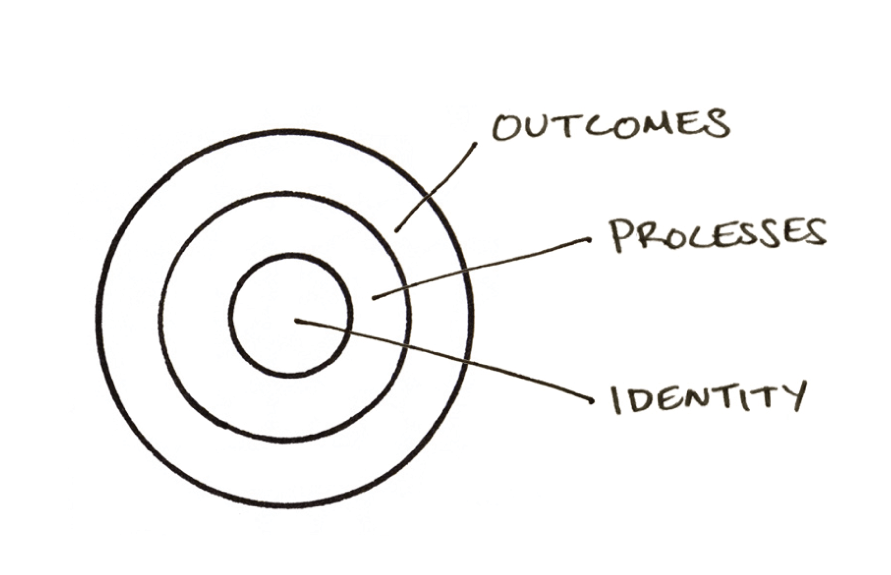
The first layer is changing your outcomes. This level is concerned with changing your results.
The second layer is changing your process.This level is concerned with changing your habits and systems:
The third and deepest layer is changing your identity. This level is concerned with changing your inner beliefs and principles.
To summarize,
Outcomes are about what you get. Processes are about what you do. Identity is about what you believe.
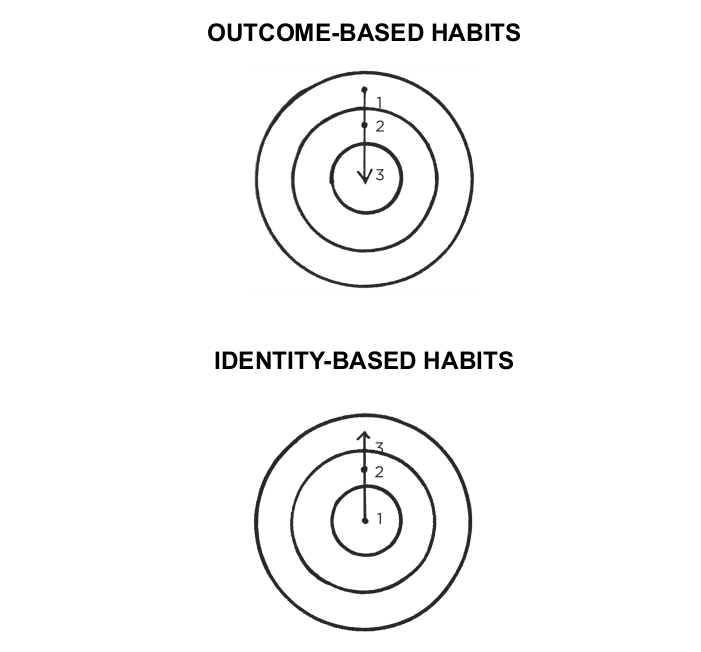
Most of us, at most of the times begin the process of changing our habits by focusing on what we want to achieve. Losing those 5 Kgs, reading those 5 books, waking up at 7 AM and so on. This leads us to outcome-based habits.
The alternative is to build identity-based habits. Start from the inner most layer. With this approach, we start by focusing first on who we wish to become. And as you’ll find out, this will make all the difference in the world.
Why Beliefs are Like a Really Big Deal?
I know what you are thinking. I still don’t understand why this change of direction is a big deal. What difference does it make?
It’s a big deal because our beliefs are much more important in our lives than we give them credit for. And I have talked about this before.
Why Belief?
Because it’s the starting point of everything. The thoughts you’ll have, the actions you’ll take, the decisions you’ll make and the person you’ll become.
To drive this point home, let me share with you a brilliant example from the book, that showcases the difference perfectly.
Imagine two people resisting a cigarette. When offered a smoke, the first person says, “No thanks. I’m trying to quit.” It sounds like a reasonable response, but this person still believes they are a smoker who is trying to be something else. They are hoping their behavior(the outcome) will change while carrying around the same beliefs.
The second person declines by saying, “No thanks. I’m not a smoker.” It’s a small difference, but this statement signals a shift in identity. Smoking was part of their former life, not their current one. They no longer identify as someone who smokes.
It’s hard to change your habits if you never change the underlying beliefs that led to your past behavior.
When I read this statement in the book, it reminded me of a personal story of behavior change that started last year. And I’d like to share that with anyone who is reading this.
Up until February of last year, a sedentary life style and a late night snacking habit had got the better of me. The result was a 23 year old weighing 80 Kgs with a whopping BMI of 29, which is very bad and unhealthy. One fine day, I decided that this needs to change. And I went through all the usual suspects.
Made goals.
Started exercising.
Changed my diet habits.
Cut down on sugar.
Even motivated myself by imagining beach holidays.
And so on.
But as I write this, I realize that the most important thing I did was to start seeing myself as a healthy athletic person. And that’s because, I had read a piece of advice somewhere that said “If you are on a fat loss journey and feel like slipping back, ask yourself this when making a decision — Is this what a healthy person would do?”
No, I hadn’t read this book back then nor did I have any inkling about the concept of identity based habit formation. But come to think of it, what I essentially did was try and change my inner beliefs first.
A year later, I weigh 67 Kgs with a BMI below 25, which is considered to be healthy and normal. And I would attribute this to a fundamental change in the way I saw myself as a person.
Because it’s one thing to say I’m the type of person who wants this. It’s something very different to say I’m the type of person who is this.
So once again, remember that it’s hard to change your habits if you never change the underlying beliefs that led to your past behavior. You may have all the new goals and new plans of achieving those goals, but if you haven’t changed who you are, it will never last.
What’s The Type of Person You’d Vote For?
I know I might have pushed the theory bit too hard in trying to convey this idea of identity based habits. Let me now talk about how one might put this theory to practice in everyday, real life.
By now, I am assuming we all understand the power of forming identity driven habits. Hence, the obvious subsequent question is,
“How do we go about forming a new identity?
How do we start identifying ourselves as this new person that we wish to become? What is the practical next step I can take today?”
In the book, James talks about a simple two-step process:
1. Decide the type of person you want to be.
2. Prove it to yourself with small wins.
No, we are not born with preset beliefs. Babies don’t come into the world with an Identity Manual. We learn and form those things gradually — through experience, through the things we do and by the actions we take everyday.
Think about this.
Whatever your identity is right now, you only believe it because you have proof of it. The more evidence you have for a belief, the more strongly you will believe it.
When I started this blog, I decided I will write one new article every week. And I did that for a few months. Back then, I had no doubt in saying that I was a writer, because the proof was right there, every week.
But in the recent months, I have not written regularly. Maybe once or twice in a couple of months. Do I still identify myself as a writer? Maybe, but this identity is definitely not as strong as before.
The point is that random, one-off experiences or actions taken just a few times, fade away. You are not a singer because you sang that one song at that one party a couple of years ago.
But the more you repeat a behavior, the more you reinforce the identity associated with that behavior. Do you work out 95% of the days, come what may? Then yes, you can identify yourself as an athletic person.
Each new habit that you are trying to form is like a suggestion: “Hey, maybe this is who I am.”
(Step 1)And every action you take is a vote for the type of person you wish to become. No single instance will transform your beliefs, but as the votes build up, so does the evidence of your new identity. (Step 2)
And once you identify yourself as this new type of person, it is much more easier to align yourself to a new behavior or a new habit.
As James says in his book,
The most practical way to change who you are is to change what you do.
Conclusion
I believe that learning the science and psychology behind habit formation and behavior change is an important meta-skill that everyone of us should possess.
In this article, my attempt was to distill some of the best research in this field and contextualize it for a very common challenge or problem, that all of us face at some point of time in our lives. I hope that the ideas and examples that I have mentioned here help you in becoming a better version of yourself, as they have definitely helped me.
So, the next time you are faced with the struggle of a new habit formation or a behavior change, try asking yourself “Who is the type of person that could get the outcome I want?”
And as James says in his book, “The focus should always be on becoming that type of person, not getting a particular outcome.”